1 Your fairway ball is in ground under repair
Free relief is available when ground under repair affects your ball, intended stance or swing. The nearest point of complete relief is a spot for the ball, not your feet. Use the club, stance and swing you would have used without the repair area. Try nearby positions where the ball, feet and intended swing are all clear; identify where the ball would sit at each. Choose the spot closest to the original ball, no nearer the hole, in the general area (including fairway and rough). Mark that reference point with a tee. Drop within one club-length, no nearer the hole, in the general area and fully clear of the interference. The nearest spot may be in rough. Relief is normally optional unless it is a no play zone. A worn patch is not automatically ground under repair. Rule 16.1; Nearest point explained.
2 Tree roots are beside or under your ball
Normally, no free drop. Roots are part of the course, and concern about your wrists or club does not itself create relief. Check for a Local Rule treating specified roots as ground under repair; it may exclude stance-only interference. Otherwise, play as it lies or use unplayable-ball relief outside a penalty area. For one penalty stroke, the options are replaying from the previous spot, back-on-the-line relief or lateral relief within two club-lengths, no nearer the hole. Rule 19.2; Model Local Rule F-9.
3 Your bunker ball is resting on a rake
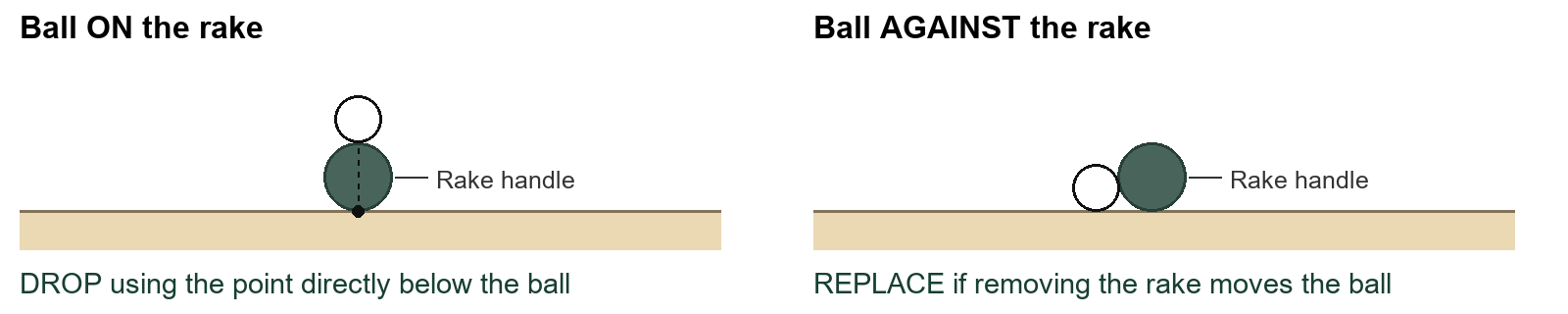
If the ball is supported by the rake, lift it and remove the rake. The reference point is on the sand vertically beneath the ball’s original position, as if you lowered a plumb line from the ball. Drop from knee height within one club-length of that point, no nearer the hole, in the same bunker. If it rolls but stops inside that relief area, play it where it stops. If a correct drop rolls outside the relief area, drop again from knee height. If the second correct drop also finishes outside, place a ball by hand on the spot where that second drop first touched the sand. You may not gently place it to avoid plugging. If a correct drop stays in the relief area but digs into the sand, play that lie or take unplayable-ball relief with a penalty. A poor lie alone does not allow another drop.
If the ball instead rests on sand against the rake, remove the rake. If the ball moves, replace it by hand on its original spot without penalty; do not drop it. If it will not stay when replaced, follow Rule 14.2e or call an official. Rule 15.2a; Rules 14.2 and 14.3; Rule 19.3.
4 Your ball is in an old fairway divot
There is no automatic free relief from an ordinary divot hole. Play as it lies unless an applicable Local Rule allows otherwise. Do not press down or replace turf to improve the lie before your stroke. Rule 8.1a.
5 Your ball sits in a freshly punched fairway hole
An aeration hole does not automatically earn free relief. If the Committee adopts Model Local Rule E-4, a ball in or touching one qualifies. In the fairway, find the nearest point, no nearer the hole, where the ball is clear of the hole, then drop from knee height within one club-length, no nearer the hole, in the general area. Stance or swing interference alone does not qualify. If it finishes in another aeration hole, you may take relief again. Model Local Rule E-4.
6 Cart paths and colored stakes interfere
Even with the ball on grass, interference with your normal stance or swing can qualify for free relief. Use situation 1 and take complete relief; an unreasonable stance cannot create entitlement.
White stakes marking out of bounds are boundary objects: no free relief, and you cannot move them to improve your shot. Red or yellow stakes mark penalty areas and are normally movable obstructions. You may remove a movable stake, even with your ball inside the penalty area; if this moves the ball, replace it by hand without penalty. If the stake is immovable, Rule 16.1 relief requires the ball to be outside the penalty area. Check the Local Rules for any special designation. Rule 15.2; Rule 16.1; Boundary objects.
7 A sprinkler head blocks your putt from the fringe
Line-of-play interference alone normally gives no free relief when your ball is off the green. A Local Rule based on F-5 may allow it, typically when the obstruction is within two club-lengths of both the green and ball. Check the event’s exact wording; F-5.2 also restricts the permitted grass height. Model Local Rules F-5.1 and F-5.2.
8 A loose leaf is touching your ball in a bunker
You may remove loose leaves and stones. But if removing one moves your ball, normally add one penalty stroke and replace the ball. This differs from the rake: a leaf is a loose impediment; a rake is a movable obstruction. Rule 15.1.
9 You accidentally nudge your ball on the green
Before starting your stroke, you accidentally tap the ball with your putter. There is no penalty: replace it on its original spot, estimating if necessary. This protection applies on the putting green; do not assume the same result in the fairway. Rule 13.1d.
Make the drop correctly
Measure a club-length using the longest club you carry that round, other than your putter. Drop straight down from knee height. The ball must land and finish in the required relief area. If two correct drops finish outside it, place a ball where the second drop first touched the ground. Rule 14.3; Club-length definition.
When nobody is sure
Ask a referee without unreasonably delaying play. In stroke play, decide to play two balls before your next stroke and announce which you want to count if allowed. Report the facts to the Committee before returning your scorecard, even if both scores match; failing to report means disqualification. This procedure is unavailable in match play. Rule 20.1.